
The MySafeMenu
Menu Standard
Present item-level allergen information clearly on printed and digital menus.
Download standard assetsVersion 3.2.7 · September 22, 2026
Grilled chicken sandwich
Grilled chicken, lettuce and tomato on a buttered bun.



Overview
The MySafeMenu Menu Standard defines how to present ingredient allergens, cross-contact risks, and information gaps for the nine major US food allergens on printed and digital menus.
Verification
Before labeling a dish, thoroughly review its complete recipe, supplier information, and preparation process. Complete the checks below for each dish and variation before adding allergen declarations to the menu.
- Review direct allergens.
For each dish and each of the nine allergens, record whether it is present, absent after review, or unknown. Check supplier labels and compound ingredients.
- Assess cross-contact allergens.
Review suppliers, storage, shared oil and water, equipment, and service. Record risks that remain after controls.
- Mark gaps as unverified.
If supplier information or the kitchen assessment is incomplete, leave that allergen unverified.
- Keep all versions aligned.
Record the location, recipe version, reviewer, and review date. Update the printed menu, online menu, and staff record before serving a changed dish.
Anatomy
Grilled chicken sandwich
Grilled chicken, lettuce and tomato on a buttered bun.
Shared preparation equipment.
- A · Description
- Describe the dish normally. Where applicable, name the fish species, crustacean, or individual tree nut. Name other relevant allergens here too; see Beyond the nine major allergens.
- B · Contains
- The icons identify allergens used as ingredients in the menu item.
- C · May contain
- A separate line identifies allergens that could enter the dish through cross-contact, even though they are not ingredients. A brief note can explain where the risk arises.
Two ways to show icons
Icons can sit below the description or beside the item name. The May contain line sits below the description in both examples.
Below the description
Grilled chicken sandwich
Grilled chicken, lettuce and tomato on a buttered bun.
Shared preparation equipment.
Beside the item name
Grilled chicken sandwich
Grilled chicken, lettuce and tomato on a buttered bun.
Shared preparation equipment.
Grayscale printing
On a black-and-white menu, grayscale versions keep the same symbols. A full-size print proof helps confirm that each remains distinct and legible.
Grilled chicken sandwich
Grilled chicken, lettuce and tomato on a buttered bun.
Menu appendix
A labeled icon key can go at the end of a multi-page menu or along the bottom of a single page. These layouts show all nine symbols in color and grayscale.
Allergen icon key
Milk Egg
Egg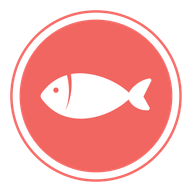 Fish
Fish Crustacean shellfish
 Tree nuts
 PeanutWheat
 SoySesame
Allergen icon key
MilkEggFishCrustacean shellfishTree nutsPeanutWheatSoySesameAllergen icon key
MilkEggFishCrustacean shellfishTree nutsPeanutWheatSoySesameAllergen icon key
MilkEggFishCrustacean shellfishTree nutsPeanutWheatSoySesameDeclaration states
Ingredient presence and cross-contact are different findings. A dish may have neither, either, or both for a given allergen.
Contains
Identifies allergens used as ingredients in any part of the default serving, including sauces, sides, and garnishes.
Salmon & shrimp salad
Salmon, shrimp, mixed leaves, almonds, walnuts and lemon–olive oil dressing.
May contain
Identifies an assessed risk that an allergen could enter the dish unintentionally, such as through shared equipment or preparation surfaces. It is separate from ingredients in the recipe. Review the actual process and controls before adding a warning; the allergen’s presence elsewhere in the kitchen alone is not enough.
Grilled vegetable plate
Zucchini, peppers and potatoes with olive oil and herbs.
Shared utensils and preparation surfaces.
Not yet verified
Name the allergen whose status is unknown. Keep any confirmed Contains or May contain declarations visible.
Roasted vegetable flatbread
Roasted peppers, zucchini and mozzarella on flatbread.
Flatbread supplier information is pending. Ask staff before ordering.
Wheat and gluten are separate
Track gluten separately when you provide gluten information. Barley and rye can contain gluten even when wheat is absent. A gluten-free claim needs separate evidence and preparation controls.
Allergen icons
Each icon represents one of the nine major US allergen groups. The same symbol identifies an allergen whether it appears in Contains or May contain.

Milk from cows, goats, sheep, and other ruminants, including ingredients containing their milk proteins.
#00A7D8
Eggs from chickens, ducks, geese, quail, and other domesticated fowl, including ingredients containing their egg proteins.
#00A7D8
Finfish such as cod, salmon, and tuna, including ingredients containing fish proteins. Identify the species.
#1F78BF
Crustaceans such as shrimp, crab, and lobster, including ingredients containing their proteins. Identify the species. Molluscs are a separate group.
#D75E63
Nuts such as almonds, cashews, hazelnuts, pecans, pistachios, and walnuts, including ingredients containing their proteins. Identify each nut. Peanuts are separate.
#8D5A14
Peanuts are legumes. This category includes peanut butter, peanut flour, and ingredients containing peanut proteins.
#9A5A15
Triticum species, including common wheat, durum, and spelt, and ingredients containing their proteins. Wheat-free does not mean gluten-free.
#F69B1D
Soybeans and ingredients containing soy proteins, including tofu, edamame, and soy protein isolates.
#2DB34A
Sesame seeds and ingredients containing sesame proteins, including tahini and sesame flour.
#DFB46B20 pxStandard digital menu32 pxExpanded detail48 pxIcon appendixBeyond the nine major allergens
Other allergens guests may need to identify include molluscs, mustard, celery, lupin, sulphites, and gluten-containing grains such as barley and rye. Name relevant ingredients in the dish description rather than adding a second set of unlabeled icons or grouping them as “Other.” The nine-group icons still identify any Big 9 ingredients.
Ginger vegetables
Roasted vegetables with oyster sauce (oysters, soy, wheat), mustard and ginger.
Usage examples
Name specific fish, crustaceans, and nuts
Seafood salad
Cod, shrimp and almonds with mixed leaves and lemon dressing.
Seafood and nut salad
Mixed seafood and nuts with greens.
The icons name the allergen groups; the description identifies cod, shrimp, and almonds.
Separate ingredients and cross-contact
Creamed spinach
Spinach with cream and herbs.
Shared equipment.
Creamed spinach
Spinach with cream and herbs.
Allergens: milk, peanut.
A single “Allergens” list does not tell guests whether peanut is an ingredient or a cross-contact risk.
Describe a substitution
Keep declarations for the standard dish visible. Verify the ingredients and preparation of any offered modification separately.
Classic cheeseburger
Beef patty, cheddar, lettuce and tomato on a wheat bun.
Can be made milk-free
Identify allergens introduced by a substitution. Use “allergy-friendly” or “gluten-free” only when those claims have been verified.
Specifications
Place declarations directly on the menu’s paper background, without a separate box or shadow.
Grilled chicken sandwich
Grilled chicken, lettuce and tomato on a buttered bun.
Shared preparation equipment.
| Element | Specification | Behavior |
|---|---|---|
| Declaration text | 12 pt minimum | Set labels in regular-weight italics with 1.25× line height. |
| Allergen icon | 6 × 6 mm minimum | Use the supplied high-resolution PNG artwork. |
| Space between icons | 1.5 mm | Wrap at the end of a row; do not shrink icons to fit. |
| Description to declarations | 2 mm | Align declarations with the item name, not the price. |
| Between declaration lines | 1 mm | Keep Contains and May contain on separate lines. |
| Between dishes | 6 mm minimum | Keep each dish and its declarations on the same page. |
Crowded menus
Wrap declarations or provide a clearly labeled companion allergen menu. Match dish and variant names exactly across both menus. Do not reduce text or icon size, and do not make a QR code the only way to read declarations.
Grayscale printing
Use grayscale versions of the icons and their labeled appendix. Review a printed proof at full size.
Digital
Keep the same declaration wording and icon order online. A card around each dish is optional.
- Text and contrast
- Use at least 16 px body text and a 4.5:1 contrast ratio. Declaration labels must remain legible.
- Icon size and spacing
- Use 20 px icons with 3 px between them. Separate declaration lines clearly.
- Small screens
- Move Contains icons below the description if they crowd the title. Keep May contain below the description. Show every icon; do not collapse a list into “+3.”
- Accessible names
- Expose each icon’s allergen name to assistive technology. Keep the labeled appendix visible on the same menu.
- Access and controls
- Show declarations without sign-in or interaction. Give any interactive control a target of at least 44 × 44 px and visible keyboard focus.
Grilled chicken sandwich
Grilled chicken, lettuce and tomato on a buttered bun.
Shared preparation equipment.
Downloads
Use these files to apply the standard to printed and digital menus.
Download individual PNGs in Allergen icons. Print the menu template at 100% scale or save it as a PDF. The source artwork measures 3733 × 3733 px; keep printed icons at least 6 mm wide.